Most people believe money only loses value when prices visibly go up. They look at inflation charts, news headlines, or price tags at the store and assume that purchasing power changes only when those numbers move.
Understanding why money loses value is crucial for anyone looking to maintain their purchasing power.
Understanding why money loses value is crucial for financial awareness.
Recognizing why money loses value helps in making informed financial decisions.
That belief is incomplete.
Why money loses value can be observed through various economic indicators.
By recognizing why money loses value, individuals can make more informed financial decisions.
Understanding why money loses value can help individuals better navigate financial uncertainties.
Grasping the concept of why money loses value can empower individuals to protect their assets.
In reality, money often starts losing its real value long before official prices rise. The process is quiet, gradual, and largely psychological. By the time inflation becomes obvious, the damage has usually already been done, illustrating why money loses value.
Understanding this hidden phase is essential for anyone trying to make sense of modern economic behavior.
People often overlook the reasons why money loses value in everyday transactions.
As consumers, we must be aware of why money loses value in the long run.
We must understand why money loses value to safeguard our purchasing power.
To combat this issue, understanding why money loses value is essential.
The Difference Between Nominal Value and Real Value
Awareness of why money loses value aids in better budgeting strategies.
Every individual should consider why money loses value when planning their finances.
Understanding Why Money Loses Value
Understanding why money loses value is essential for financial literacy.
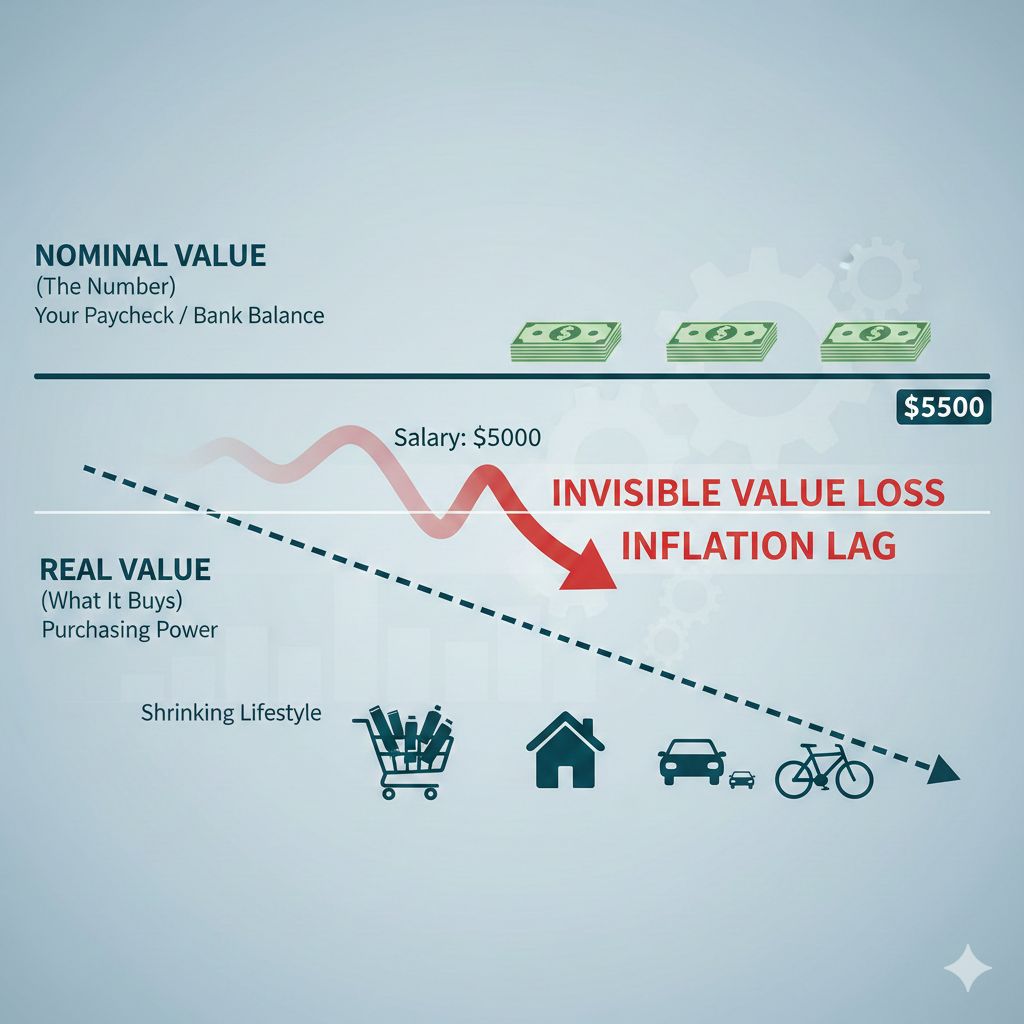
Money has two values at the same time.
Nominal Value
This is the number printed on your paycheck, bank balance, or currency note.
Exploring economic cycles can explain why money loses value over time.
Understanding why money loses value helps in forecasting future financial trends.
Surveying market changes reveals why money loses value.
Many factors contribute to why money loses value, influencing consumer behavior.
Real Value
This is what that money can actually buy in the real world.
When people say “my money is worth less,” they are talking about real value, not nominal value.
The problem is that real value can decline even when nominal value stays the same.
According to Investopedia, real value reflects the actual purchasing power of money after accounting for changes in economic conditions, even when nominal figures remain unchanged.
The mechanisms of why money loses value can be subtle yet impactful.
Recognizing why money loses value is vital for maintaining financial health.
Financial literacy involves understanding why money loses value and its implications.
Why Price Changes Lag Behind Economic Reality
Prices do not move instantly. They adjust slowly due to contracts, consumer expectations, business strategies, and government reporting methods.
Various economic factors illustrate why money loses value over time.
It’s vital to comprehend why money loses value to safeguard against economic shifts.
Recognizing why money loses value is the first step towards financial empowerment.
Focusing on why money loses value ensures better investment strategies.
Businesses Delay Price Increases
Companies often absorb rising costs temporarily instead of raising prices immediately. They may:
- Reduce package sizes
- Lower product quality
- Cut services or benefits
- Delay upgrades
Consumers feel the loss, but prices appear unchanged.
Official Inflation Is Backward-Looking
Most inflation measurements are based on past data. By the time inflation is reported, the erosion of purchasing power has already happened.
Adapting to changes requires understanding why money loses value.
This delay creates a false sense of stability.
Awareness of why money loses value can assist in better planning for the future.
The Role of Monetary Expansion
One of the most important drivers of early value loss is money supply growth.
When more money enters the system:
- The value of each unit decreases
- Purchasing power spreads thinner
- Prices eventually adjust upward
This adjustment does not happen immediately. It happens in stages.
First Stage: Asset Inflation
Before consumer prices rise, assets such as real estate, stocks, and commodities often increase first.
This creates inequality between:
- People who own assets
- People who rely only on wages
At this stage, prices at the grocery store may look stable, but money is already losing strength.
Psychological Inflation Comes Before Price Inflation
People adjust their behavior before prices change.
Spending Feels Less Satisfying
To maintain value, one must comprehend why money loses value in today’s economy.
Consumers notice they need to think harder before buying things that used to feel affordable.
Saving Feels Pointless
When money earns little or no return, people feel discouraged from saving, even if prices are stable.
Financial Anxiety Increases
Households feel pressure without being able to explain why.
This psychological shift is often the first sign of real value loss.
Wages Do Not Adjust in Real Time
Even when economies grow, wages usually lag behind.
- Salaries are adjusted annually or less
- Inflation effects are continuous
- Cost-of-living changes are uneven
Discussing why money loses value is necessary for informed economic policies.
As a result, workers lose purchasing power quietly, month after month, without a visible price shock.
How Fixed Prices Can Hide Declining Value
Some prices remain stable by design:
- Subscription services
- Rent contracts
- Utility rates
- Tuition fees (temporarily)
But stability does not mean fairness.
Many may wonder why money loses value and how it affects their savings.
When these prices eventually change, they often jump suddenly, revealing a loss that has been accumulating for years.
The question of why money loses value is more relevant than ever.
Part One Summary
Before prices rise:
- Money supply expands
- Asset prices move first
- Wages lag behind
- Psychological pressure increases
- Real value erodes silently
Understanding why money loses value can guide responsible spending habits.
Understanding why money loses value is a fundamental aspect of economic literacy.
Most people notice inflation only when it becomes visible. By then, purchasing power has already declined.
The Illusion of Stability in Everyday Life
One of the main reasons people fail to recognize declining purchasing power is the illusion of stability. Daily life often looks unchanged. Prices appear familiar, salaries arrive on time, and routines remain intact. This surface-level normality convinces people that money retains the same value it always had.
In reality, stability in appearance does not equal stability in value. Economic shifts tend to happen quietly. Instead of dramatic price increases, value erodes slowly through subtle changes that feel insignificant on their own. Over time, these small changes accumulate into real financial pressure.
Time as the Silent Force Behind Value Loss
Educating others on why money loses value can enhance community financial literacy.
Many financial advisors emphasize why money loses value in their consultations.
People must continually ask themselves why money loses value to make informed choices.
Everyone should understand why money loses value to navigate financial landscapes.
Time plays a critical role in how money loses value, even when prices remain stable. Each passing month without meaningful income growth or purchasing power improvement slightly weakens financial position. Because this process lacks a clear starting point or visible moment of impact, it is often ignored.
Delayed consequences are particularly difficult to detect. When people postpone financial adjustments or purchases, assuming stability will continue, they often face higher costs later. What feels like patience or caution can feel, in hindsight, like missed opportunity. The loss is not sudden, but it is persistent.
Awareness of why money loses value can lead to better financial choices.
Why Gradual Change Feels Normal
Human psychology is poorly equipped to detect slow decline. People are naturally sensitive to sudden shocks but largely indifferent to gradual change. This is why a sharp increase in prices triggers immediate concern, while years of slow erosion pass without alarm.
Memory also plays a role. Individuals tend to compare current conditions to recent experiences rather than long-term trends. As long as yesterday feels similar to today, the assumption is that nothing meaningful has changed. This mental shortcut makes long-term value loss feel invisible.
The False Security of Fixed Prices
This article explains why money loses value and its implications.
Fixed prices often create a sense of financial security. Rent agreements, subscriptions, and service contracts can remain unchanged for long periods, reinforcing the belief that costs are under control. However, these fixed prices exist within an economy that continues to evolve.
When adjustments finally occur, they are often sudden and significant. What feels like an unexpected increase is usually the result of years of accumulated pressure. The stability was real in appearance but temporary in function.
To mitigate risks, one must understand why money loses value over time.
Ultimately, understanding why money loses value is key to financial survival.
Value Loss Without Obvious Price Increases
Not all inflation appears as higher numbers on price tags. Value loss frequently occurs through changes in quality, quantity, or convenience. Products may last for shorter periods, services may offer less support, and replacements may become more frequent. Consumers end up paying more over time without seeing an immediate price increase.
This form of hidden inflation is particularly difficult to measure, yet it affects everyday life just as strongly as visible price changes.
Behavioral Shifts Caused by Silent Erosion
As purchasing power declines quietly, behavior begins to change. People adjust by working more, relying on credit, or reducing long-term planning. These shifts happen gradually and often feel like personal choices rather than responses to economic pressure.
Over time, financial stress becomes normalized. People assume they are managing poorly, when in reality the system itself has reduced the effectiveness of their money.
Why Awareness Matters More Than Certainty
Understanding how money loses value before prices rise is not about predicting economic events or offering solutions. It is about recognizing patterns. Awareness allows individuals to interpret financial pressure more accurately and avoid false assumptions about stability.
This understanding strengthens financial literacy and helps explain why financial strain can exist even in periods of low reported inflation.
Closing Perspective
Money rarely loses value in a single moment. It fades gradually, often unnoticed, until the effects become impossible to ignore. By the time prices visibly rise, purchasing power has often been declining for years.
That is why money often loses value long before prices actually rise.

How Money Loses Value Over Time (Even If Prices Look Stable)