Introduction
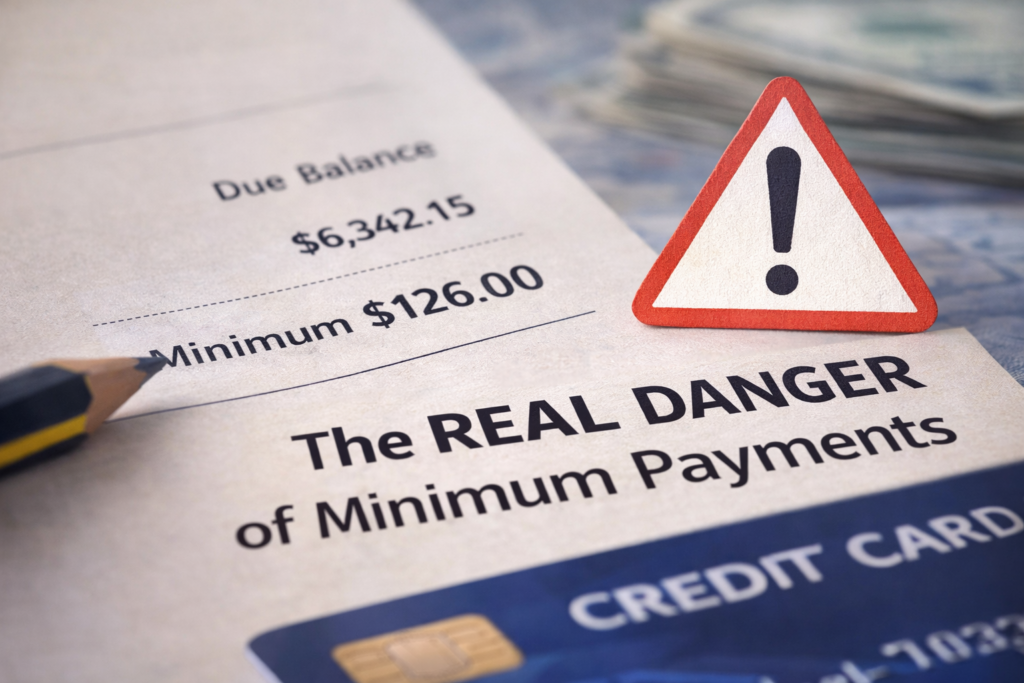
A minimum payment on a credit card statement looks harmless. It is small, predictable, and designed to feel manageable. When people pay it every month, they believe they are handling their debt responsibly.
In reality, the minimum payment system works against the borrower. It slows progress, maximizes interest costs, and quietly extends repayment timelines far beyond what most people expect. The danger is not missed payments. The danger is staying compliant while making no real progress.
Understanding how minimum payments function is essential before considering solutions like credit balance transfer options or strategies for how to pay off credit card debt effectively.
How Minimum Payments Actually Work
Credit card issuers calculate the minimum payment using formulas that prioritize interest recovery over balance reduction. The most common methods include:
- A fixed percentage of the total balance
- Interest charges plus a small portion of principal
- A flat minimum dollar amount, whichever is higher
What matters is not the formula itself, but the outcome. In the early stages of repayment, most of the minimum payment goes toward interest, not toward reducing the balance.
This structure causes three long-term effects:
- The balance decreases very slowly
- Interest continues to compound month after month
- The repayment period stretches far longer than expected
From the lender’s perspective, this system is efficient. From the borrower’s perspective, it creates the illusion of progress without meaningful results.
Why Minimum Payments Barely Reduce Your Balance
To understand the real issue, it is important to separate payment activity from debt reduction.
Making a payment feels productive. However, progress only exists when the principal balance declines at a meaningful rate. With minimum payments, that decline is minimal.
This happens because:
- Interest is calculated continuously
- High APR causes interest to accumulate quickly
- Small payments barely exceed interest charges
As a result, the minimum payment often functions as an interest maintenance fee rather than a payoff strategy.
Financial guidance published by the Consumer Financial Protection Bureau explains that minimum payments are structured to extend repayment timelines, even when borrowers never miss a due date..
The Psychological Trap of Minimum Payments
Minimum payments are not only a financial mechanism. They are also a behavioral tool.
They reduce stress by:
- Lowering the required monthly action
- Removing urgency from the debt
- Creating a sense of compliance and control
Once a debt feels manageable, it stops feeling dangerous. That emotional shift is what keeps balances active for years.
Most people do not stay in debt because they are careless. They stay in debt because the system encourages comfort instead of resolution.
A Simple Example That Shows the Real Cost
Imagine a credit card balance of $5,000 with a typical interest rate.
- Paying only the minimum payment can stretch repayment over a decade
- Total interest paid may approach or exceed the original balance
- Increasing the monthly payment even slightly can reduce the payoff time by several years
This gap between perception and reality is what traps borrowers. The debt does not feel urgent, but the cost continues to grow quietly in the background.
At this stage, many people begin exploring alternatives such as low interest credit cards or considering whether a 0 interest balance transfer could reduce interest exposure. Those options only make sense once the core problem is clearly understood.
Why Credit Card Issuers Prefer Minimum Payments
Minimum payments benefit lenders because they:
- Keep balances active for longer periods
- Generate consistent interest revenue
- Reduce default risk by keeping payments affordable
From a business perspective, this structure works exactly as intended. From a consumer perspective, it delays financial freedom.
Educational resources like Investopedia note that minimum payments are intentionally set low to prolong repayment without triggering immediate financial distress.
What Actually Reduces Credit Card Debt Over Time
Reducing credit card debt is not about making payments more often. It is about changing how each payment affects the balance.
Debt starts shrinking faster when:
- Payments are set above the minimum payment
- More of each payment is directed toward the balance itself
- Interest exposure is reduced intentionally, not passively
Even small adjustments can create noticeable differences. Increasing a payment by a modest amount can shorten repayment timelines dramatically, especially in the early stages of debt.
This is why learning how to pay off credit card debt effectively requires more than discipline. It requires structure.
When a Credit Balance Transfer Is Useful — and When It Fails
A credit balance transfer can be helpful, but only under very specific conditions. It is a tool, not a solution.
It may be effective when:
- The interest reduction is meaningful
- Transfer costs are reasonable relative to the balance
- The borrower has a clear plan to reduce the balance during the lower-interest period
It becomes ineffective when:
- Spending habits remain unchanged
- Payments remain close to the minimum
- New balances are added elsewhere
In those cases, the debt is not reduced. It is simply relocated.
How Low Interest Credit Cards Change the Equation
Some borrowers look toward low interest credit cards as a way to regain control. Lower interest rates can help, but only in limited ways.
Lower rates can:
- Limit how quickly interest accumulates
- Make payments more impactful over time
- Reduce long-term cost pressure
However, lower interest does not eliminate debt by itself. It only reduces resistance. Progress still depends on consistent, intentional payments that exceed the minimum.
Understanding 0 Interest Balance Transfer Periods
A 0 interest balance transfer temporarily removes interest from the equation. During this window, payments can reduce the balance more efficiently.
The risk appears after the promotional period ends.
If the remaining balance is still large, interest resumes—often at a higher rate. When payments slow during the interest-free phase, borrowers may lose the advantage they initially gained.
These offers work best when paired with a defined payoff timeline, not when treated as a pause button.
A Practical Way to Think About Credit Card Repayment
A sustainable approach to debt repayment follows three principles:
- Stop using the minimum payment as a measure of success
- Commit to a fixed monthly amount that actively reduces the balance
- Use interest-reduction options only alongside deliberate repayment behavior
This approach shifts the focus from compliance to control.
Public guidance from the Consumer Financial Protection Bureau (CFPB) consistently emphasizes that structured repayment strategies lead to better outcomes than minimum-based repayment alone.
Final Thoughts
Minimum payments are designed to keep debt stable, not to remove it.
Once borrowers understand how the system works, the sense of safety disappears. What replaces it is clarity—clear numbers, clear timelines, and clear choices.
Debt freedom does not come from finding the perfect financial product. It comes from replacing passive habits with active decisions.
Disclaimer
This article is intended for educational purposes only and should not be considered financial, legal, or investment advice. Credit terms, interest rates, and repayment options vary depending on individual circumstances and financial institutions. Readers should seek guidance from official financial resources or qualified professionals before making decisions related to credit or debt management.
How Interest Rates Shape Everyday Financial Decisions