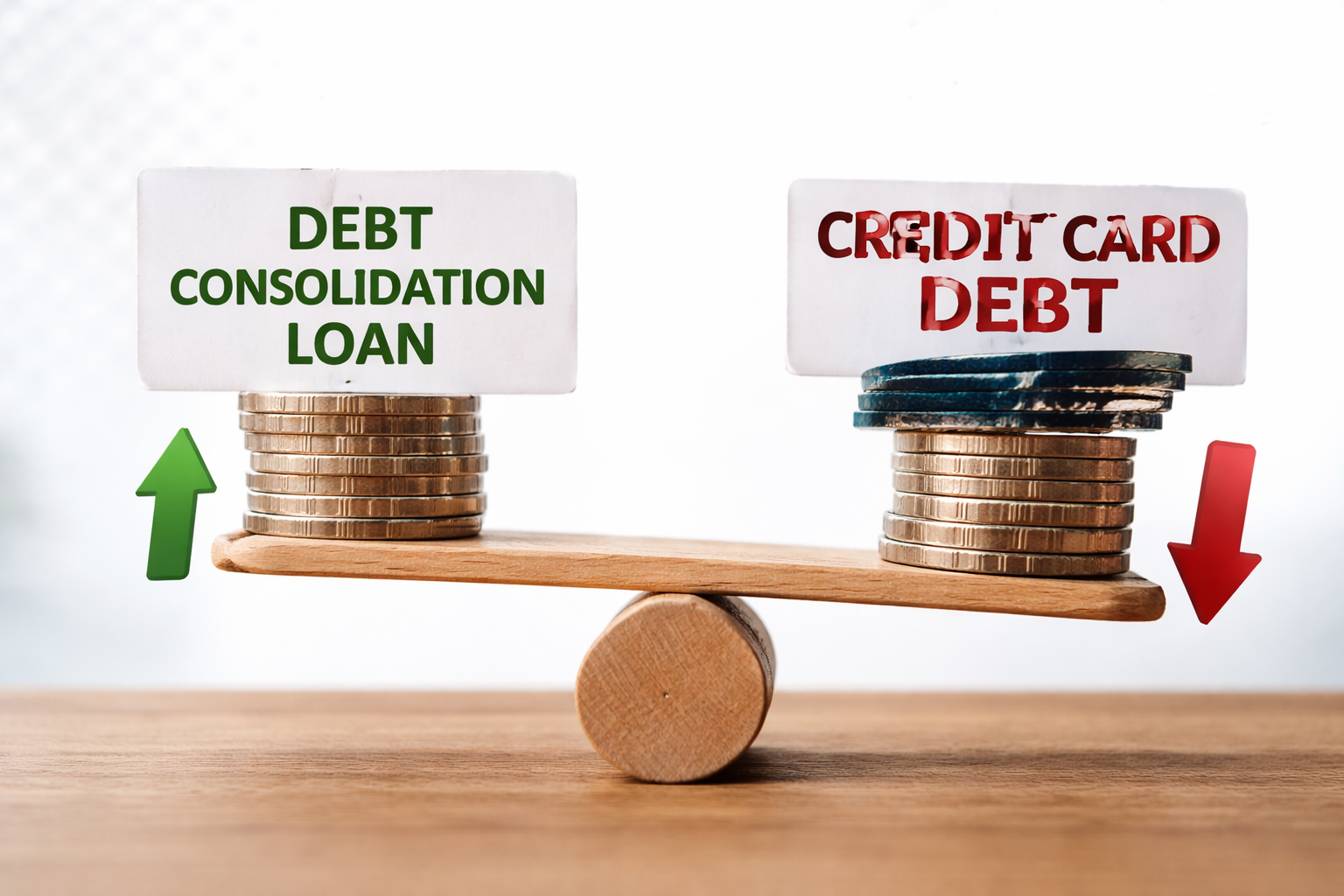
At some point, credit card debt stops feeling temporary.
Balances linger. Payments repeat. And despite regular effort, the total owed barely moves.
This is usually the moment people start searching for alternatives—and a debt consolidation loan quickly appears as the most common suggestion.
The promise sounds simple: replace scattered credit card balances with one structured loan and reduce long-term cost.
But simplicity can be misleading.
To understand whether a debt consolidation loan truly costs less than credit card debt, you have to look past surface comparisons and examine how each system behaves over time.
Why Credit Card Debt Becomes Difficult to Escape
Credit cards are not designed for long repayment cycles. Their structure prioritizes flexibility, not resolution.
Interest grows quietly in the background
Unlike installment loans, credit card interest accumulates continuously while balances remain open. Even when payments are made on time, interest keeps rebuilding the balance in the background.
This creates a situation where:
- Payments feel productive
- Balances decline slowly
- Total cost increases without obvious warning
Minimum payments create false momentum
Minimum payments are calculated to keep accounts active, not to eliminate debt quickly. Paying only the minimum stretches repayment timelines and increases total interest paid.
Over time, borrowers may remain financially responsible while making almost no real progress.
What a Debt Consolidation Loan Actually Changes
A debt consolidation loan does not eliminate debt.
It changes how debt behaves.
Instead of revolving balances that reset every month, consolidation converts debt into a fixed repayment schedule.
Structural differences matter more than rates
With a consolidation loan:
- The balance declines on a set schedule
- Each payment reduces principal predictably
- The debt has a defined endpoint
This removes uncertainty. You know exactly when the debt will end—as long as payments continue.
Debt Consolidation Loan vs Credit Card Debt: A Structural Comparison
The cost difference between these two options is rarely about motivation.
It’s about design.
Credit card debt operates with:
- Open-ended timelines
- Variable interest exposure
- Continuous borrowing availability
A debt consolidation loan operates with:
- Fixed repayment length
- Stable monthly obligations
- No access to additional spending
This single difference—open-ended vs closed repayment—often determines total cost more than interest percentages alone.
When a Debt Consolidation Loan Can Reduce Total Cost
A debt consolidation loan can be financially beneficial when it introduces discipline that credit cards lack.
Predictable payments create accountability
Because the loan cannot be reused once funds are applied, progress is automatic. Each payment moves the balance closer to zero without relying on willpower or constant decision-making.
Reduced interest exposure over time
Even modest reductions in interest, combined with structured repayment, can significantly reduce the total amount paid over several years.
The benefit comes from consistency, not short-term savings.
When Consolidation Fails to Deliver Savings
This is where many people miscalculate.
Behavior overrides structure
If credit cards remain active and spending resumes, consolidation simply adds another obligation instead of replacing the original one.
In that scenario:
- Total debt increases
- Interest exposure expands
- The loan becomes a liability, not a solution
Longer terms can hide real cost
Lower monthly payments may feel like progress while extending repayment long enough to increase total interest paid.
Cheaper monthly does not always mean cheaper overall.
The Real Question People Rarely Ask
The real issue is not whether a debt consolidation loan is cheaper on paper.
The real question is whether it changes the system that created the debt in the first place.
Without that change, consolidation reorganizes debt—it doesn’t reduce its impact.

Debt Consolidation Loan vs Credit Card Debt: Looking at the Real Cost
When comparing a debt consolidation loan with credit card debt, the true difference does not appear in the first few months. It becomes visible only over time.
Credit card balances tend to remain flexible. Payments reduce the balance, but access to credit stays open. This flexibility makes debt easier to carry—and harder to eliminate.
A debt consolidation loan removes that flexibility entirely.
Once credit card balances are paid off using a loan, the repayment path becomes fixed. There are no revolving limits, no optional payments, and no opportunity for balances to quietly rebuild.
That structural change is what alters long-term cost.
According to guidance from a U.S. consumer protection authority, debt consolidation loans tend to be most effective when they replace high-interest credit card balances and are paired with consistent repayment behavior.
How a Debt Consolidation Loan Changes the Repayment Outcome
The primary advantage of a debt consolidation loan is not psychological relief. It is mechanical.
One direction only
With credit cards, balances can move in both directions.
With a loan, they move in one direction—down.
Each payment reduces the principal according to a schedule that cannot be altered without missing payments entirely. This creates measurable progress regardless of motivation or financial confidence.
Credit Card Consolidation Loan vs Balance Transfer Strategies
Some borrowers consider balance transfer cards instead of a debt consolidation loan. On paper, temporary low-interest offers may appear cheaper.
In practice, balance transfers rely on precision:
- Promotional deadlines must be met
- Fees apply upfront
- New charges often restart interest accumulation
A credit card consolidation loan does not rely on timing or optimization. Its effectiveness comes from consistency, not execution perfection.
For borrowers managing long-standing credit card debt, consistency usually outperforms promotional strategies over time.
Situations Where a Debt Consolidation Loan Fits Best
A debt consolidation loan tends to work best when it addresses both structure and behavior.
It is most effective for individuals who:
- Carry persistent credit card debt
- Pay a significant portion of interest monthly
- Prefer predictable repayment
- Intend to pause credit card usage during repayment
In these cases, consolidation converts ongoing financial friction into a finite obligation.
When a Debt Consolidation Loan Creates New Problems
A debt consolidation loan can become counterproductive if it is used as a reset rather than a replacement.
Problems arise when:
- Credit cards remain actively used after consolidation
- The loan term stretches repayment unnecessarily
- Monthly payments are reduced at the cost of long-term expense
In these scenarios, consolidation improves appearance but worsens financial exposure.
What Ultimately Determines Which Option Costs More
The cost difference between credit card debt and a debt consolidation loan is not determined by effort or awareness.
It is determined by constraints.
Credit cards offer flexibility, which increases long-term cost.
Debt consolidation loans impose limits, which reduce it.
For borrowers who need control rather than convenience, constraints are what lower total cost over time.
Final Assessment
In most long-term scenarios, credit card debt results in higher overall cost because it allows debt to remain open indefinitely.
A debt consolidation loan usually reduces total cost by forcing closure—provided that new debt is not added during repayment.
The deciding factor is not the product itself, but how completely it replaces existing debt behavior.
Disclaimer
This article is provided for general educational insight only. It does not offer individualized financial recommendations or endorse specific financial products. Loan costs, repayment terms, and financial outcomes vary depending on personal circumstances, credit history, and lender requirements. Readers should independently assess their financial situation and seek professional guidance when evaluating debt-related decisions.
How Credit Card Debt Quietly Destroys Financial Stability Over Time