When Money Quietly Shrinks
Many people assume that money only loses value when prices visibly rise. If rent stays the same, groceries look familiar, and bills don’t shock them, they believe their financial position is stable. In reality, this assumption is misleading.
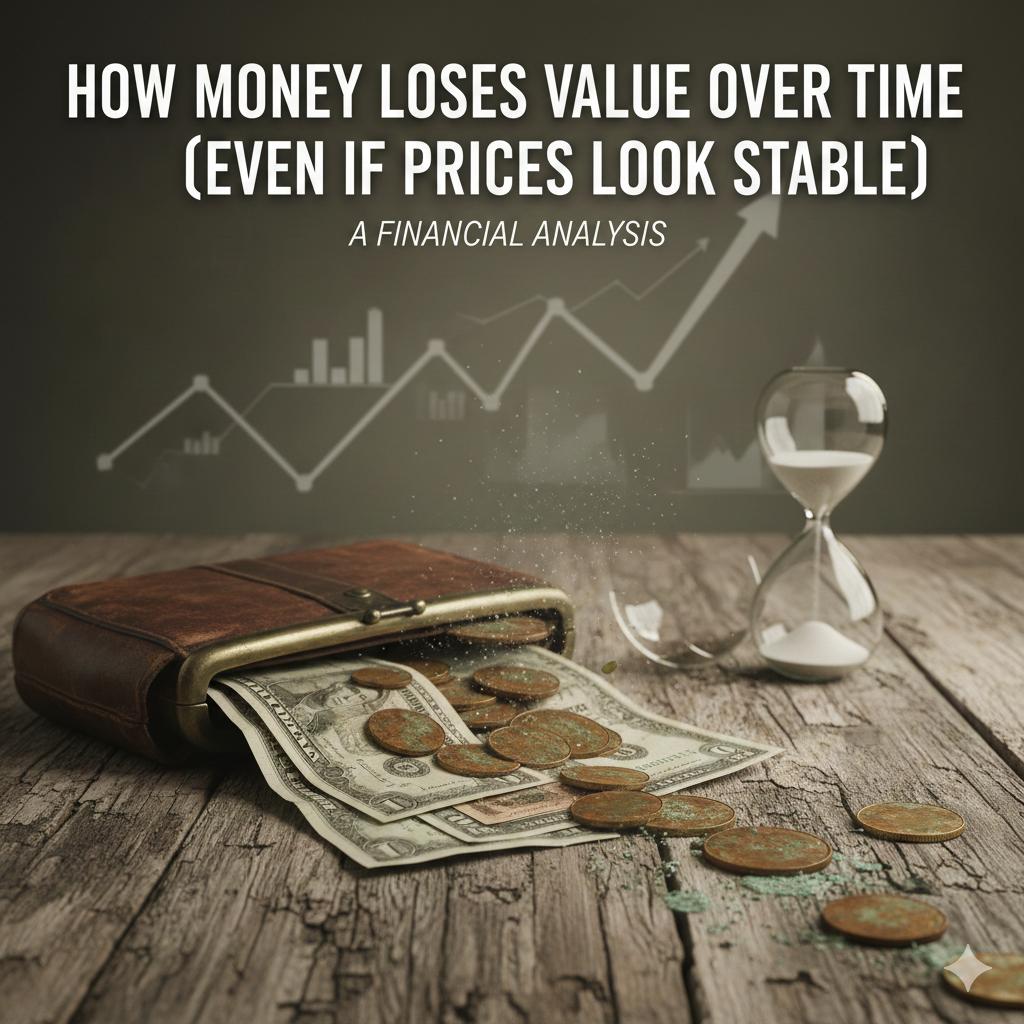
Money can lose value even when prices appear stable. This happens slowly, quietly, and often without triggering alarm. Over time, this invisible erosion affects savings, income, and purchasing power, making people feel financially stuck without understanding why.
This article explains how money loses value beneath the surface — without offering financial advice — and why awareness of this concept matters more than most people realize.
Price Stability vs. Value Stability
Why These Two Are Not the Same
Price stability refers to what you see on price tags. Value stability refers to what your money can actually do for you over time. These are not identical.
A product may cost the same today as it did last year, but:
- Its quality may be lower
- Its size may be smaller
- Its lifespan may be shorter
Your money hasn’t changed numerically, but its real usefulness has declined.
Nominal Value and Real Purchasing Power
Nominal value is the number printed on money. Real purchasing power is what that money can realistically buy across time.
If your income or savings remain unchanged while the economic environment shifts, the nominal value stays constant, but the real value quietly shrinks.
This distinction explains why people often feel poorer without earning less.
According to Investopedia, purchasing power refers to the amount of goods and services that a unit of currency can buy over time, which helps explain why money can lose real value even when nominal amounts stay the same.
Inflation Is Only Part of the Story
Why Low Inflation Doesn’t Mean Safety
Inflation is often blamed as the sole reason money loses value. While inflation plays a role, it is not the only mechanism.
Money can lose value even when:
- Official inflation is low
- Prices rise very slowly
- Central banks claim economic stability
The erosion simply becomes harder to detect.
Statistical Inflation vs. Lived Inflation
Official inflation measurements are based on average baskets of goods. Real life is not average.
Households spend differently. What matters to one person may not matter to another. As a result, many people experience higher real inflation than reported, without realizing it.
Shrinkflation: The Invisible Value Thief
What Shrinkflation Actually Is
Shrinkflation occurs when companies reduce quantity or quality instead of raising prices.
Examples include:
- Smaller food portions
- Lower-quality ingredients
- Fewer service features
- Reduced durability
The price remains unchanged, but the value declines.
Why It Works So Well
Shrinkflation succeeds because:
- People focus on price, not volume
- Changes are gradual
- Familiar packaging creates false consistency
Over time, money buys less substance without triggering resistance.
Money Supply and Silent Dilution
How Currency Expansion Affects Value
When more money enters an economy, each unit represents a smaller share of total economic output.
Even if prices don’t immediately rise:
- Savings lose relative strength
- Asset prices absorb excess money
- Wage growth lags behind monetary growth
This creates a gap between numbers and reality.
Purchasing Power Is Relative, Not Fixed
Purchasing power depends on context:
- Income growth
- Productivity
- Economic demand
If these move faster than wages or savings, money quietly falls behind.

Time: The Most Overlooked Factor
Why Small Losses Slowly Turn Into Real Limitations
The decline of money’s value almost never feels urgent. It doesn’t arrive with sharp warnings or sudden disruptions. Instead, it unfolds quietly, shaped by time rather than events, and that is precisely why it often goes unnoticed.
In a single year, a slight reduction in purchasing power barely registers. Life continues. Bills are paid, routines remain stable, and there is no obvious reason to worry. Because nothing breaks immediately, most people dismiss the change as irrelevant.
The problem emerges later. When that same small decline repeats itself across multiple years, it reshapes what money can realistically provide. Options become narrower. Flexibility decreases. What once felt comfortable starts to feel constrained, even though nothing dramatic ever happened.
This is how time amplifies small disadvantages. Gradual change avoids attention, yet produces lasting consequences.
Choosing Stability Can Still Mean Accepting Loss
Keeping money unchanged often feels like a responsible decision. Stability offers psychological relief, especially during uncertain economic periods. However, unchanged numbers do not guarantee unchanged value.
Money does not exist in isolation. While balances remain the same, economic conditions evolve, costs adjust, and expectations shift. Over time, money that appears stable on paper can lose practical influence.
Ignoring this process does not stop it. It simply means allowing it to continue without awareness. The goal of this discussion is not to promote action, but to improve understanding. Once people recognize how time affects value, financial frustration becomes easier to explain.
Clarity replaces confusion. Context replaces self-blame.
Income Stability and Economic Movement
Why Earning the Same Does Not Mean Standing Still
A consistent income creates a sense of security. Many assume that if their pay does not decline, their financial position remains intact. Over longer periods, this assumption often proves misleading.
When income stays flat:
- Everyday costs absorb a greater share of earnings
- Long-term objectives require more effort to reach
- Financial breathing room gradually disappears
This outcome is not always tied to poor money management. In many cases, income simply fails to keep pace with broader economic changes happening quietly in the background.
As a result, people feel disciplined yet stagnant. The explanation lies beyond personal behavior and within structural economic shifts.
Growth at the Top Does Not Mean Progress for Everyone
Economic growth is frequently framed as a collective achievement. Rising productivity, expanding markets, and positive indicators dominate public discussion. However, these gains are not evenly shared.
Economic expansion often concentrates within:
- Assets and capital
- Large organizations
- Higher-income groups
For many individuals, conditions remain unchanged. Their income may look stable, but their relative position weakens. This disconnect explains why encouraging economic headlines can coexist with widespread personal financial pressure.
Understanding this divide helps separate economic narratives from lived experience.
Behavioral Changes Caused by Gradual Erosion
Adjustment Happens Before Awareness
When money loses value slowly, people adapt without realizing it. These adaptations feel natural, even logical, which makes them difficult to identify.
Common adjustments include:
- Reducing long-term ambitions
- Reframing limitations as personal choice
- Postponing goals indefinitely
Over time, expectations shrink to match reality. What was once temporary becomes normalized, without clear recognition of the forces involved.
The Emotional Weight of Invisible Decline
Gradual erosion creates pressure without a clear source. There is no single moment to blame, yet financial stress increases. Many internalize this pressure, assuming personal responsibility for outcomes shaped by broader conditions.
Recognizing the role of time helps separate individual decisions from economic context. This distinction encourages clearer thinking and reduces unnecessary self-criticism.
A Familiar Pattern: Same Income, Fewer Options
Consider someone earning the same amount for several years:
- No sudden price jumps
- No visible inflation spikes
- No dramatic lifestyle changes
Yet over time:
- Saving becomes more difficult
- Unexpected expenses feel heavier
- Long-term plans lose momentum
Nothing was taken away directly. Still, something changed. Not income — but value.
Internal Linking Context
This topic aligns closely with everyday budgeting behavior. For additional perspective and deeper context, link internally to:
How People Really Budget vs. How They Think They Budget
This connection improves topical relevance and strengthens on-site engagement.
External Reference (One Trusted Source)
For a broader explanation of purchasing power and real monetary value, refer to Investopedia and its educational resources on purchasing power and inflation dynamics.
Final Thoughts
Money does not lose its practical impact only during periods of high inflation or major economic crises. In many cases, its influence fades gradually as time passes and broader economic conditions evolve in the background.
This slow shift often explains why financial progress feels slower than expected. Even when income remains consistent and spending habits do not change, underlying value can still weaken without obvious warning signs.
Looking at money from this perspective helps explain the disconnect many people feel between effort and results. It shifts attention away from surface-level numbers and toward the long-term forces that quietly shape financial outcomes.
Disclaimer
This article is intended to discuss economic concepts in a general and educational context only. It is designed to support understanding, not to guide or influence individual financial choices.
Nothing in this content should be interpreted as financial, legal, investment, or professional advice. Readers should evaluate their own situations independently and seek qualified assistance where appropriate.
Any decisions, interpretations, or actions taken based on the information provided remain entirely the responsibility of the reader.