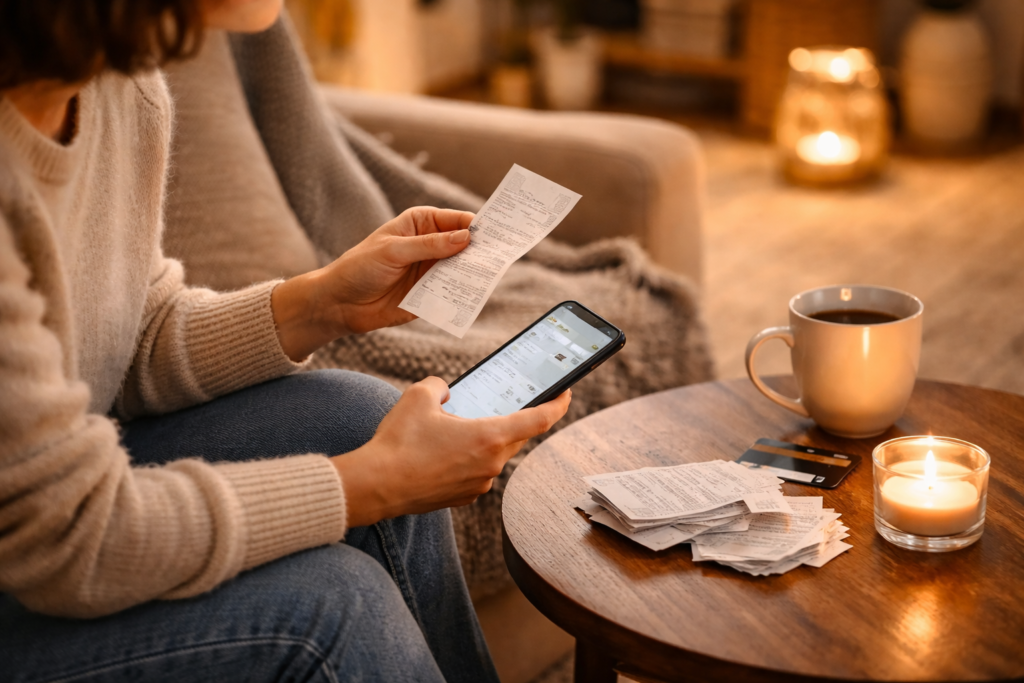
The Illusion of Harmless Spending
Small purchases slip into daily life without resistance. They are quick, familiar, and emotionally neutral. There is no internal debate when tapping a card for a coffee, upgrading a delivery option, or renewing a low-cost subscription. The decision feels automatic, almost invisible.
That invisibility is the problem.
Financial control rarely breaks because of a single bad decision. It weakens when decisions stop feeling like decisions at all. When spending becomes frictionless, intention quietly disappears.
Most people associate financial mistakes with obvious events: large purchases, debt accumulation, or income loss. Small purchases do not fit that narrative, so they escape scrutiny entirely.
How the Brain Downplays Small Financial Choices
The human brain is not designed to measure cumulative impact accurately. It reacts to isolated events, not patterns.
A small expense feels insignificant because it creates no emotional signal. There is no sense of loss, no discomfort, and no urgency. As a result, the brain categorizes the expense as safe.
Once categorized as safe, the expense no longer triggers evaluation. The mind does not ask:
- Is this necessary?
- Is this aligned with my priorities?
- What behavior does this reinforce?
Instead, the action feels justified by default.
This is not a willpower issue. It is a cognitive shortcut.
Why Repetition Is More Damaging Than Amount
A single small purchase has no power on its own. The damage comes from repetition.
Repeated small spending reshapes behavior in subtle ways:
- It normalizes impulse responses
- It reduces awareness of money leaving the account
- It shifts spending from conscious choice to habit
Over time, spending becomes the automatic response to minor discomforts—fatigue, boredom, stress, convenience. The brain learns that spending solves small problems quickly, and that lesson sticks.
This explains why many people feel financially constrained without being able to point to a clear mistake. The issue is not one bad decision. It is a pattern that formed without attention.
The Gap Between Awareness and Control
Many people believe the solution is better tracking. They monitor transactions, categorize expenses, and review monthly totals. This creates a sense of responsibility, but it does not restore control.
Awareness happens after the fact.
Control happens before the action.
If the decision is already automatic, tracking it later does nothing to interrupt the behavior. The same triggers will produce the same responses tomorrow.
This is why people can be highly informed about their finances and still feel out of control. Information alone does not alter habits.
The Psychological Cost That Builds Quietly
The real damage caused by small purchases is psychological, not numerical.
Over time, people experience:
- Reduced sensitivity to spending
- A growing disconnect between effort and results
- Frustration without a clear source
- A feeling of financial drift
This creates internal conflict. Someone may believe they are being careful, yet their financial position does not reflect that effort. The confusion leads to self-blame or resignation, even though the issue was never a lack of discipline.
Why Small Purchases Feel Safe Until They Aren’t
Small purchases feel safe because they never trigger immediate consequences. There is no visible penalty, no sudden loss, and no clear signal that something is wrong.
But safety created by scale is an illusion.
When behavior changes without awareness, control erodes without warning. By the time discomfort appears, the habit is already embedded.
The Core Insight
Small purchases do not weaken financial control because they cost money.
They weaken it because they train the brain to act without intention.
When spending becomes effortless, control becomes optional. And when control becomes optional, stability slowly fades—quietly, consistently, and often unnoticed.

Why Small Purchases Slowly Redefine Financial Behavior
Small purchases do more than reduce a bank balance. Over time, they redefine how a person relates to money. Each effortless transaction lowers the mental barrier required to spend. What once felt optional becomes routine, and what felt routine becomes invisible.
This pattern aligns with behavioral finance research, which shows that repeated low-cost decisions gradually shape financial behavior more than isolated large purchases.
This shift happens quietly. There is no moment where control is clearly lost. Instead, spending behavior changes in the background while attention remains focused elsewhere.
Eventually, financial decisions stop feeling intentional. They feel automatic.
How Spending Defaults Are Created
Every repeated behavior creates a default.
When small purchases happen frequently, the brain learns a simple rule: spending is an acceptable response to minor discomfort or inconvenience. That rule becomes internalized.
Common triggers include:
- Mental fatigue at the end of the day
- Mild stress or emotional discomfort
- Desire for convenience over effort
- Need for small rewards
Because the cost is low, the brain never challenges the response. Over time, spending becomes the default reaction rather than a conscious choice.
This is how financial behavior shifts without permission.
The Problem With Asking “Can I Afford This?”
Most people evaluate purchases using a single question:
“Can I afford this?”
For small purchases, the answer is almost always yes.
But affordability is not the right filter. It ignores long-term impact and focuses only on immediate capacity. As a result, decisions feel justified even when they weaken overall control.
A better question would be:
“What pattern does this reinforce?”
Small purchases matter because they shape patterns, not because they drain accounts instantly.
Why Financial Discipline Feels Harder Over Time
As small purchases accumulate, discipline becomes harder—not easier.
This happens because:
- Spending resistance weakens
- Sensitivity to loss decreases
- The emotional reward of convenience increases
Eventually, even reasonable limits start to feel restrictive. Attempts to “cut back” feel uncomfortable because the habit is already embedded.
At this stage, people often blame motivation or income, when the real issue is behavioral conditioning.
The False Sense of Stability Small Purchases Create
Ironically, small purchases often coexist with a sense of responsibility. People pay their bills, avoid major debt, and manage obvious expenses. On the surface, everything looks stable.
Underneath, control is slipping.
This creates a dangerous gap:
“I’m doing everything right.”
“But my finances don’t feel stable.”
That gap is usually filled by small, repeated decisions that were never examined closely enough to correct.
Restoring Control Without Extreme Restriction
Regaining financial control does not require eliminating every small purchase. That approach creates resistance and usually fails.
Control returns when spending decisions regain friction.
This happens when:
- Automatic decisions are slowed down
- Habits are evaluated as patterns, not events
- Spending is linked to intention rather than emotion
The goal is not perfection. It is awareness at the moment of choice.
The Long-Term Impact People Underestimate
Small purchases shape more than monthly budgets. They influence:
- Confidence in money management
- Sense of personal control
- Willingness to plan long-term
- Emotional relationship with spending
When spending feels unmanaged, even small financial challenges feel overwhelming. When spending feels intentional, stability follows—even without drastic changes.
The Final Insight
Small purchases do not destroy financial control suddenly.
They erode it gradually by replacing intention with habit.
Once spending becomes the default response, control requires conscious effort to reclaim. The earlier this pattern is recognized, the easier it is to reverse.
Financial stability is not built by avoiding large mistakes alone. It is built by paying attention to the smallest decisions—before they decide for you.