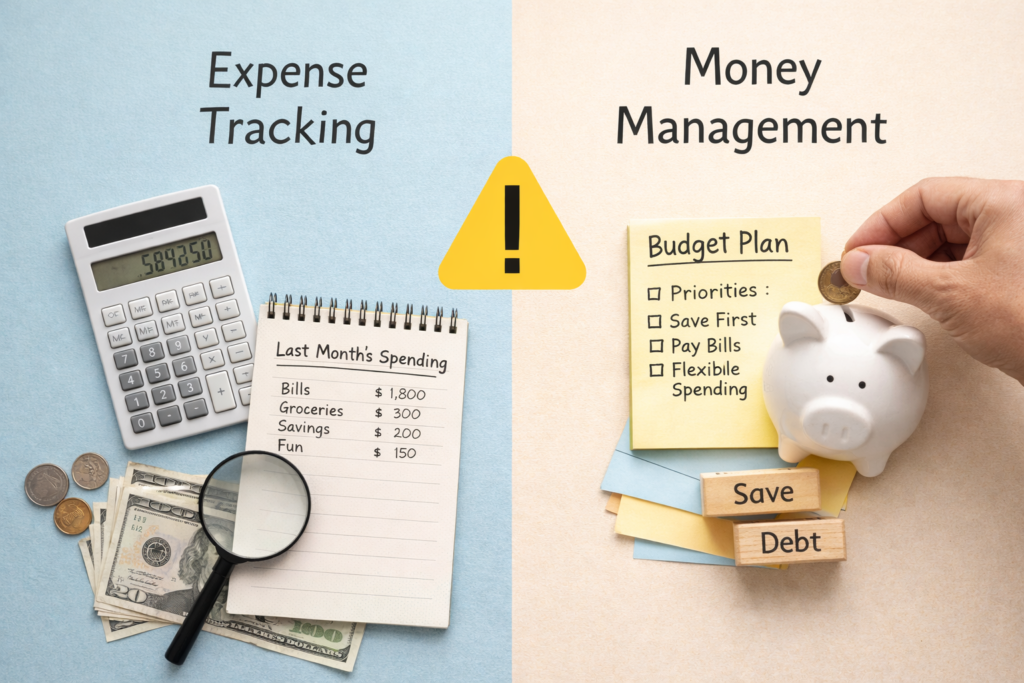
The Limits of Expense Tracking
Why Tracking Expenses Feels Like Financial Control
Many people believe they are managing their money simply because they track their expenses. They record every transaction, categorize spending, and review totals at the end of the month. On the surface, this behavior looks responsible and disciplined. It creates the impression that nothing is hidden and everything is under control.
Tracking expenses is essential for understanding your financial habits. By consistently tracking expenses, individuals can identify patterns that may lead to overspending and make necessary adjustments.
Engaging in tracking expenses helps create a comprehensive overview of where funds are allocated, making it easier to formulate a plan for saving.
Expense tracking creates clarity. Clarity feels productive because it replaces uncertainty with numbers. When people know exactly where their money went, they feel informed and organized. That feeling alone convinces many individuals that they are financially responsible, even if their situation has not actually improved.
The problem is that feeling informed is not the same as being financially stable.
Tracking expenses effectively reveals areas where one can cut back, thus freeing up resources for more important financial goals.
Incorporating tracking expenses into your financial routine can unveil unexpected habits that may be hindering your financial progress.
Awareness Is Not the Same as Progress
Ultimately, tracking expenses serves as a foundation for making informed decisions about future spending, leading to greater financial health.
The biggest limitation of expense tracking is that it focuses entirely on the past. It documents what already happened instead of shaping what will happen next. Knowing that you overspent last month does not automatically prevent overspending this month.
By consistently tracking expenses, individuals can enhance their ability to manage and allocate resources effectively.
Tracking expenses enables individuals to visualize their spending, making it easier to identify areas that require adjustment.
When tracking expenses, individuals often discover recurring costs that can be minimized or eliminated altogether.
Tracking expenses works well as a diagnostic tool. It exposes spending habits, highlights recurring costs, and reveals financial leaks such as forgotten subscriptions or impulse purchases. These insights are useful, but they are passive. They depend entirely on motivation and self-control to produce change.
Over time, motivation weakens.
Effective tracking expenses can lead to better financial decision-making and ultimately more significant savings.
This is why many people track expenses for years without meaningful improvement. They become experts at documenting their financial problems instead of solving them. Awareness increases, but outcomes remain the same. The numbers are accurate, but behavior does not change.
With a focus on tracking expenses, it becomes easier to align spending with personal values and goals.
The Illusion of Control
Another common issue is the illusion of control. Detailed spending reports create a sense of authority, even when no real decisions are changing. People confuse visibility with control. They know where their money goes, but they do not decide where it must go.
Seeing spending patterns does not automatically create boundaries. Without predefined limits or priorities, awareness simply becomes observation. People watch their financial behavior without having the tools to redirect it.
By prioritizing tracking expenses, individuals can proactively address financial challenges before they escalate.
This illusion is dangerous because it delays real change. People feel like they are “doing something” financially, even while repeating the same mistakes month after month.
Expense Tracking Ignores Timing and Structure
Expense tracking does not manage timing. Income arrives on specific dates. Bills are due on specific dates. When these timelines do not align, financial stress increases regardless of income level. Someone can earn enough money and still feel constantly behind if cash flow timing is poorly structured.
Tracking expenses does nothing to fix this mismatch.
Integrating tracking expenses into one’s financial routine can lead to improved financial literacy over time.
Expense tracking also does not enforce priorities. It records spending after decisions are already made. If saving, debt repayment, or emergency buffers were not protected before spending began, tracking cannot repair the damage afterward.
Effective tracking expenses allows individuals to set realistic budgets that reflect true spending habits.
This is why many budgets fail. They are built from expense history rather than financial structure. People look at last month’s numbers and try to adjust emotionally. They promise to spend less or save more without changing how money flows through their accounts.
Tracking expenses can highlight financial trends and cycles that might otherwise go unnoticed.
Ultimately, the practice of diligently tracking expenses can lead to increased financial confidence over time.
Regularly tracking expenses can empower individuals to take control of their financial destiny.
Why Budgets Based on Tracking Collapse
Real life interferes. Unexpected costs appear. Fixed expenses limit flexibility. Discipline fades under pressure. When the system relies on willpower instead of structure, the budget collapses.
Tracking expenses becomes the main strategy, and budgeting turns into a cycle of intention followed by disappointment. Each month starts with good intentions and ends with the same results. The data is accurate, but the system is weak.
Expense tracking documents financial behavior. It does not design it.
Until money is guided by structure instead of observation, tracking expenses will continue to feel productive without producing real financial stability.
The habit of tracking expenses can serve as a catalyst for making positive financial changes.
How Real Money Management Creates Financial Stability

Money Management Is About Design, Not Observation
Real money management is not about watching money move. It is about deciding how money should move before any transaction takes place. While expense tracking records behavior after it happens, managing money is about designing behavior in advance.
This difference explains why many people feel financially aware but remain financially unstable. Awareness alone does not prevent mistakes. Systems do.
When money is managed intentionally, decisions are made once and repeated automatically. When money is only tracked, decisions are made repeatedly under pressure.
Cash Flow Structure Determines Daily Financial Stress
Income level alone does not determine financial stability. The structure of cash flow plays a much bigger role. When income and expenses are poorly aligned, even a solid salary can feel insufficient.
Bills that arrive before paychecks, credit card cycles that clash with income timing, and clustered obligations within the same week create constant pressure. This pressure builds stress even when total monthly income is enough.
As you track expenses, you become more aware of your financial landscape and can adjust your strategies accordingly.
Effective money management restructures cash flow where possible. It creates buffers, adjusts payment timing, and ensures obligations are supported before discretionary spending begins.
Expense tracking only reports these problems. Management systems reduce their impact.
Tracking expenses lays the groundwork for sustainable financial practices and long-term success.
Financial Priorities Must Be Built Into the System
One of the biggest weaknesses of expense tracking is that it assumes people will remember their priorities at the moment of spending. In reality, spending decisions are emotional and situational.
Managing money removes this risk by enforcing priorities automatically.
Essential expenses are protected first. Financial safety measures such as savings or buffers are secured next. Flexible spending is limited by what remains. This order is not remembered—it is built into the system.
Tracking expenses after spending occurs cannot protect priorities that were never enforced beforehand.
Why Discipline Fails Without Structure
Ultimately, the key to financial stability lies in effective tracking expenses and proactive management.
Many budgets rely heavily on discipline. People believe that awareness will motivate better decisions. Over time, this approach breaks down. Stress, fatigue, and unexpected events weaken discipline.
Money management replaces discipline with structure.
Automatic transfers, separate accounts, predefined limits, and intentional friction guide behavior quietly. These systems work even when motivation is low. They reduce decision fatigue and prevent small mistakes from becoming long-term problems.
Expense tracking assumes discipline will close the gap between awareness and action. Money management removes that assumption entirely.
Budgeting Tools Support Management — They Do Not Replace It
Budgeting apps and financial tools are useful, but they are often misunderstood. Their primary strength is tracking, not control. They visualize spending and highlight trends, but they do not redesign financial structure.
In conclusion, mastering the art of tracking expenses is critical for anyone seeking to improve their financial health.
Apps cannot align income timing. They cannot lower fixed expense pressure. They cannot enforce priorities unless the user has already built systems around them.
When tools are used without structure, they simply document financial instability more efficiently.
The Proper Role of Expense Tracking
Expense tracking has a valid role when used correctly. It works best as a feedback mechanism. Once money management systems are in place, tracking confirms whether they are functioning as intended.
It highlights gradual drift, identifies emerging issues, and supports informed adjustments. Used alone, it creates awareness without stability. Used within a system, it becomes valuable data.
Long-Term Results of Managing Money
Over time, the difference becomes clear. People who manage money experience greater stability even with average income. They recover faster from unexpected expenses and avoid recurring debt cycles.
People who only track expenses feel informed but unstable. They repeat mistakes with clarity and confuse effort with progress.
The difference is not intelligence, income, or motivation. It is structure.
Tracking expenses explains the past. Managing money designs the future through deliberate actions and planning.
External Resources
Investopedia – Personal Budgeting and Money Management
https://www.investopedia.com/personal-finance/budgeting/
Consumer Financial Protection Bureau – Budgeting Basics
https://www.consumerfinance.gov/consumer-tools/budgeting/
Federal Reserve Education – Household Financial Stability
https://www.federalreserveeducation.org/
Disclaimer
The information in this article is shared for general learning purposes only. It is not intended to serve as financial, legal, or investment guidance. All examples and explanations are based on broad concepts and hypothetical scenarios. Financial situations differ from one individual to another, and readers should evaluate their own circumstances or consult a qualified professional when appropriate.